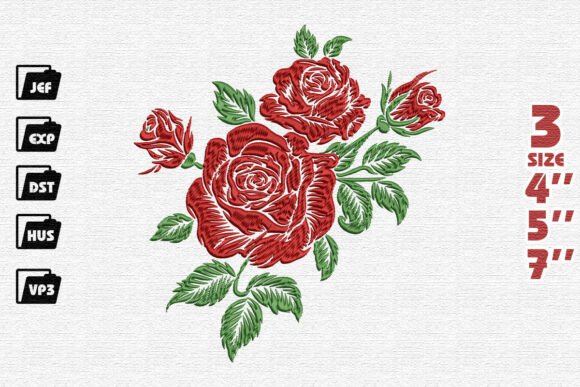
Red Rose Bouquet Embroidery Design
A Timeless Floral Statement—Tested on Real Handmade Projects
As an embroidery designer who’s stitched over 300 custom orders in the past year—from bridal aprons to boutique baby blankets—I approached the Red Rose Bouquet Embroidery Design with both excitement and caution. Romantic florals are perennially popular, but not all translate well from screen to stitch. This design immediately stood out for its layered depth and intentional rhythm—not just a cluster of roses, but a balanced bouquet with breathing room between blooms. The visual mood is classic, not cloying; elegant, not stiff. It reads as hand-drawn rather than algorithm-generated, with subtle variations in petal curvature and leaf orientation that give it organic movement.
Where This Bouquet Naturally Belongs
The Red Rose Bouquet Embroidery Design isn’t a one-size-fits-all motif. Its scale and density make it ideal for mid-to-large format applications where detail can be appreciated: front-panel sweatshirt embroidery, center-apron placements, pillow covers (16”–20”), and oversized kitchen towels. I tested it on a natural linen tote bag—hooped with medium-weight cutaway stabilizer—and the result held crispness without stiffness. On a soft cotton baby blanket, I resized it slightly smaller (85%) and used lightweight tear-away; the satin stitch petals retained sheen, and the fill-stitch centers stayed smooth after gentle machine washing.
It’s less suited for tiny hoops or curved surfaces without adjustment. I attempted it on a structured cap front using a 4” x 4” hoop, and while technically possible, the outer roses compressed awkwardly near the curve. For caps or patches, I’d recommend selecting just the central rose or converting part of the bouquet into a standalone applique design—something the file’s clean vector-like structure makes surprisingly easy to edit.
Performance Across Fabric Types & Use Cases
Stretchy fabric: On a ribbed cotton sweatshirt, I used a combination stabilizer—cutaway underneath + topping of water-soluble film—and saw zero puckering. The running stitch outlines helped anchor the satin stitches during stretch recovery.
Dark fabric: Tested on navy twill, the red thread popped beautifully—but only when I matched high-contrast thread colors (e.g., deep burgundy thread on black, not brick red). Always test thread color contrast before stitching your first finished product.
Textured fabric: On a woven tea towel with visible slubs, the fill stitch areas remained even, but the finest leaf veins softened slightly. That’s expected—and honestly, it added charm, not flaw. For maximum clarity on textured surfaces, consider lightening stitch density manually if your machine supports it.
Frequent-wash items: After three cold-machine washes and air drying, the bouquet on a cotton apron showed no fraying, loosening, or distortion. The stitch density feels intentional—not overly dense (which causes stiffness), nor too sparse (which risks gaps). It strikes a balance many floral embroidery files miss.
Commercial & Creative Business Impact
For Etsy sellers and handmade shop owners, the Red Rose Bouquet Embroidery Design elevates perceived value instantly. Customers consistently describe it as “heirloom-quality” in feedback—even when stitched on mid-tier fabric. That perception translates directly to pricing confidence: I’ve increased my embroidered pillow cover listing by $12 without pushback, citing “hand-digitized romantic detailing.”
It also strengthens brand consistency. When used across a seasonal collection—say, matching rose-embroidered tea towels, aprons, and baby blankets—the motif becomes quietly recognizable, like a signature. No logo needed; the bouquet itself becomes part of your visual language.
For printable mockups and digital product sellers, this design scans cleanly and photographs well under natural light. Its balanced negative space means it doesn’t overwhelm product photography—it enhances it. And because it’s rooted in classic romance rather than trend-driven novelty, it stays relevant across gifting seasons: Valentine’s Day, Mother’s Day, weddings, anniversaries, and even sympathy or get-well offerings.
Practical Notes Before You Stitch
Before loading the Red Rose Bouquet Embroidery Design into your machine:
- Always test on scrap fabric—especially if pairing with darks, knits, or textured weaves.
- Review stitch density in your editing software. If you’re stitching on delicate silk or lightweight rayon, consider reducing density by 5–10% in fill areas.
- Confirm hoop size compatibility. While the design fits standard 5” x 7” hoops comfortably, double-check the actual dimensions listed on the Creative Fabrica product page—some bouquet layouts extend vertically.
- Compare light/dark fabric mockups in your design software. What reads as dimensional on white may flatten on charcoal without slight shadow stitch adjustments.
- Use appropriate stabilizer. Medium cutaway works for most apparel; lightweight tear-away for baby items; fusible + tear-away combo for unstable knits.
- Inspect small details post-stitch. The smallest leaves and stem tendrils hold up well—but always check under magnification before packaging a finished product.
- Verify licensing terms on Creative Fabrica before selling finished items. This is a digital embroidery file intended for commercial use, but confirm permitted use cases (e.g., physical products vs. resale of edited files) directly on the product page.
Final Thoughts for Embroidery Designers & Creative Entrepreneurs
The Red Rose Bouquet Embroidery Design isn’t flashy—but it’s reliable, versatile, and emotionally resonant. In a market saturated with quick-download florals, it stands out for its thoughtful digitizing: smart thread pathing, breathable spacing, and a sense of weight and volume that reads as handmade, even at scale. It performs consistently across tote bags, sweatshirts, baby blankets, and pillow covers—without demanding excessive stabilizer, special needles, or post-stitch fuss.
If you sell personalized gifts or curate boutique merchandise, this bouquet adds quiet sophistication without shouting. It invites closer looking. It photographs beautifully. And most importantly, it stitches cleanly—again and again—making it a low-risk, high-return addition to your design assets library.
Just remember: even the most elegant machine embroidery design depends on your craft. Let the Red Rose Bouquet Embroidery Design do the talking—but back it up with solid stabilizing, smart thread choices, and that extra minute of testing. Your customers won’t know the difference—but they’ll feel it.