Elegant Tulip Trio Blackwork
A Quiet Statement, Not a Shout
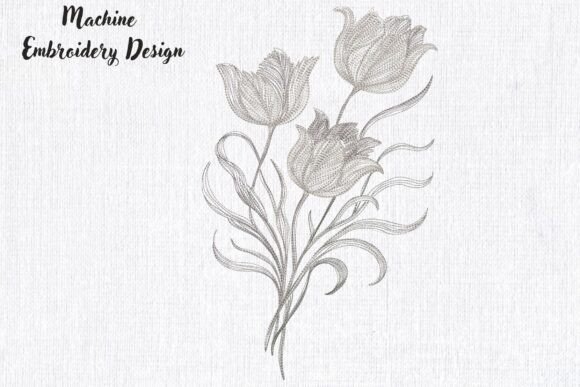
First glance at Elegant Tulip Trio Blackwork isn’t about boldness—it’s about breath. Three tulips, arranged with gentle asymmetry, their stems curving like whispered lines. No dense fill stitches, no heavy satin borders—just clean, intentional line work and subtle negative space. It feels like ink on vellum translated into thread: precise, unhurried, and quietly confident. This isn’t a design that fights for attention; it earns it through restraint. For anyone stitching custom apparel or curating boutique home goods, that distinction matters. It signals craftsmanship over clutter.
Where It Lives Best (and Why)
I recently tested Elegant Tulip Trio Blackwork on a natural linen tea towel for a small-batch kitchen collection—and it landed perfectly. The blackwork style—relying on running stitch and delicate outlines—let the fabric’s texture shine *through*, not compete with it. That same clarity carried over to a heavyweight cotton tote bag: crisp lines held up at 4.5" wide, no bleeding or distortion, even after two machine washes. It also translated beautifully onto a baby onesie in soft pima cotton—delicate enough for newborn skin, refined enough for gifting at a baby shower where parents appreciate heirloom-level detail.
For Etsy sellers and craft fair vendors, this design fits naturally into niches where subtlety sells: minimalist nursery decor, slow-living kitchenware, gender-neutral baby embroidery, and thoughtful holiday gifts (think embroidered handkerchiefs or linen napkins). As a sweatshirt embroidery option? Yes—but only on structured, medium-weight fleece or French terry. On ultra-soft, brushed cotton blends, the fine lines risk looking faint unless paired with high-contrast thread.
Where It Asks for Thoughtful Handling
- Small hoop sizes: The trio spans comfortably at ~4–5", but compressing it below 3.5" sacrifices legibility—stems blur, petal tips lose definition. Avoid forcing it into a 3" hoop unless you’re willing to simplify manually.
- Textured or stretchy fabrics: On bouclé knits or slubbed linen, the linear nature of blackwork can get visually “lost.” A lightweight tear-away stabilizer helps, but test first. On jersey or ribbed knit, skip unless using cutaway + basting spray—the design needs stability, not give.
- Dark or heavily printed backgrounds: Since Elegant Tulip Trio Blackwork relies on contrast, avoid dark fabric unless you’re stitching in bright white or ecru thread—and even then, check how it reads in natural light. It won’t pop like a bold applique design.
- Curved surfaces (caps, curved patches): The clean horizontal flow works on flat panels, but on a curved cap front, the outer tulips may distort slightly. Consider centering just one tulip instead—or using the full trio only on flat-panel items like aprons or pillow covers.
What It Adds to Your Finished Product
This isn’t just decoration—it’s quiet brand elevation. When customers see Elegant Tulip Trio Blackwork on a handmade pillow cover or personalized gift tag, they register intention: someone chose this *because* it suits the item, not because it was trendy. That builds trust. For small shop owners, that translates to repeat buyers who associate your work with care—not speed. For digital product sellers, it’s a strong anchor in a “refined floral” collection—distinct from oversaturated rose or peony bundles. And because it’s not full-fill, it stitches faster, uses less thread, and holds up better in frequent washing—key for kitchen towels or baby items.
Practical Designer Notes Before You Stitch
- Always run a test stitch on scrap fabric matching your final project’s weight and weave—even if it’s the same fiber. Linen behaves differently than cotton poplin, even at similar weights.
- Check thread color contrast on both light and dark fabric swatches. Blackwork lives or dies by readability.
- Review stitch density in your embroidery software. Since the description notes “embroidery is not full filling,” expect mostly running and back stitches—ideal for breathable wearables, but confirm no unintended dense zones in stem junctions.
- Confirm hoop size compatibility. While scalable, the balanced proportions hold best between 3.75" and 5.25".
- Inspect small details at 200% zoom: petal tips, stem intersections, and negative space between blooms. If those read cleanly on screen, they’ll read cleanly on fabric.
- Generate printable mockups in both black-and-white and grayscale—this design’s strength is tonal balance, not color.
- Use appropriate stabilizer: lightweight cutaway for knits, tear-away for stable wovens, and always baste for slippery fabrics like rayon or silk-blends.
- If selling finished items commercially, verify licensing terms—especially if bundling Elegant Tulip Trio Blackwork as part of a larger digital embroidery file pack or craft kit.
Final Thought: A Design That Respects the Maker and the Wearer
Elegant Tulip Trio Blackwork doesn’t try to be everything. It’s not a statement sleeve motif, nor a festival patch meant to shout. It’s the kind of embroidery design that makes sense when you’re stitching late at night on a gift for someone who notices the curve of a stem, the spacing between petals, the way light catches a single satin-stitched leaf vein. It suits the maker who values precision over flash—and the customer who chooses handmade because they value meaning over mass. Whether you’re an Etsy seller building a cohesive linen collection, a boutique owner refreshing seasonal merchandise, or a hobbyist embroidering a keepsake tea towel, this design doesn’t distract. It dignifies.